
I am a working mother of 4. I had my first child at 27; my mother cried like a woman possessed and told me, "You have just thrown your career away. You have no idea what you have done." Lovely, my mother, isn't she... The second came quickly too. Up to that point, things were more or less going to plan: two children, one after the other, and a reasonably stable job at a multinational pharmaceutical company. The third arrived unannounced, the little devil... I nearly had a heart attack. Pregnant? How? I rushed to the gynaecologist to see whether it was a "false positive"; my second child was 6 months old... It came at a bad moment professionally and, therefore, personally. I simply could not believe it. My usual gynaecologist gave me two pieces of advice: "Darling, where 2 can eat, 3 can eat," and, secondly, "Either you slow down or this baby will not make it to term." Those words were seared into my mind. What a dilemma... Slow down? Me? After everything it had taken to get this far... A note: my second child was born with immature lungs. I had contractions from week 30 and the doctor's diagnosis was "work-related stress the size of a cathedral".

With my third pregnancy, I was forced to change my life. I landed a project with an Israeli cosmetics company. It had always been my dream to move into cosmetics, so part of me was delighted; I saw it as an opportunity. I secured a 5-year contract and could work from home. Things were going well: I could combine an international job with a certain degree of calm in family life.
THE PROBLEM: I did not feel fulfilled at all. Working from home stressed me out. Once, during a conference call, Nico was 1 or 2 weeks old and did not stop crying throughout the meeting. When it ended, they said, "Come on, show us your baby!" I wanted the ground to swallow me up... I was permanently overwhelmed by the feeling that I was doing everything badly. Not having a team and not being able to put on my suit (my anti-impostor cape) in the morning caused me enormous stress. I felt like a bad mother and a bad professional...
Shortly after my third child was born, a headhunter called me. She said she had a position at a cosmetics company that might interest me. The problem was that the salary was nowhere near my expectations, but I wanted it so badly that I managed to reach an agreement with them. I can assure you that practically nobody around me supported the decision: "You can work from home with 3 children aged 3 years, 19 months and 3 months, yet you are going back to a multinational—and earning less? This is a joke, right?" No, it was not.

The data
Last Wednesday, the 2018 Spain Report was published. The newspaper El País covered the story with the following headline:
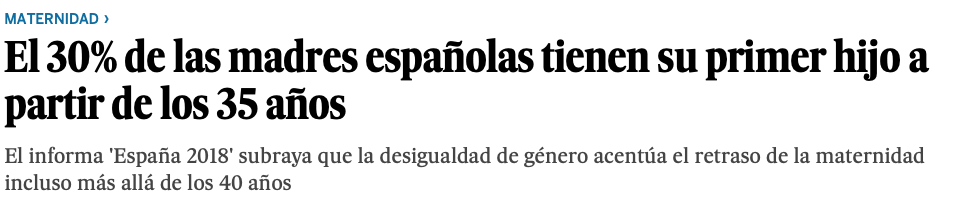
The most devastating part was inside: "Of all the births that took place in the past year, more than 30% were to women aged 35 or over, and almost 7% were to women aged 40 or over."
The report states that "the postponement of having a first child began among women with higher levels of education and greater earning potential... Women with university degrees become mothers later."
Right, fine—but which is it, then?
a) Are we not having children because we have to study?
b) Are we not having children because we cannot afford them?
c) Are we not having children because first I want job security, a fabulous flat and enough money to create a beautifully coordinated nursery that will look great in my Instagram post?
Option d would be "I don't have a partner," but nowadays that one hardly even applies! :)
Let us do a quick back-of-the-envelope calculation. Assuming you are reasonably bright: however much you enjoyed the university parties (I enjoyed them very, very much...), you finished your degree at 22 or 23. If you studied something longer, such as medicine, add another couple of years, then residency, a master's degree, a doctorate or whatever takes your fancy... Total: 28 years old. So, according to my very quick calculations, by 28 you are more than "ready" to have your first child. And then what? What explains the gap until 35? Or worse, until 40 (the 7% of first-time mothers in 2018, according to the Spain Report)?
My completely honest opinion, as they say... WE ARE TERRIFIED. We want everything to be perfect before our first child arrives: the perfect boyfriend, the perfect job, the perfect home... and perfection does not exist...

When is the best time to have children?
We contacted a gynaecologist who specialises in assisted reproduction to shed a little scientific light on the matter...
According to Dr Sol Weil Salinas, a gynaecologist specialising in assisted reproduction at Eugin Clinic:
A woman's most fertile years are between the ages of 20 and 30. From then on, female fertility begins to decline slowly.
From 35 onwards, the fertility curve falls more sharply, plummeting after 40—not only because of the number of eggs, but also because of their lower "quality".
She also adds that "lower egg quality increases the likelihood of miscarriage."
Fortunately, science has advanced and we now have the option of preserving our eggs. If we do not currently have a partner or are not entirely sure whether we want to become mothers, the key question is:
What is the best age to freeze our eggs?
Dr Weil replies: "It is advisable to preserve fertility while the ovarian reserve is good and, therefore, before 35. Once cryopreserved, eggs can remain that way for many years, but we must bear in mind that their survival rate after thawing is 85–90%. In other words, of every 10 eggs, around 8–9 will survive."
The good news, Dr Weil tells us, "is that fertilisation rates are similar to those of fresh oocytes (those that have not been cryopreserved), and there is no stipulated maximum number of cycles. In fact, it is advisable to freeze at least 9 MII oocytes (9 mature eggs). Some patients achieve this in a single cycle and others need more; once again, it depends on age. The older the patient, the more eggs will need to be cryopreserved."

This option allows us to "postpone" motherhood, but our goal must surely be for society, businesses and governments to help us become mothers when our biological age is optimal. It is all very well for companies such as Facebook and Google to pay for their employees to freeze their eggs, but beware: it is a double-edged sword...
The Nordic countries are ahead of us when it comes to work-life balance. In Sweden, they have even managed to increase the birth rate through policies that encourage work-life balance. That should be our goal—not improving science so that we can "park" motherhood.
My 3 tips if you want to be a mother without giving up your professional career.
- Integrate your child into your life, not the other way round: Our most fertile years often coincide with the point when our careers are "taking off". So, even if you slow down a little for a while, it is important to continue with your plans and adapt them to your new circumstances. Do not put them aside for too long, or inertia will start making your decisions for you... For example, if you were planning to do a master's degree, do it! Whether you become pregnant during it or begin after giving birth, the goal is, of course, for your partner to commit so that you can share responsibilities during that period.
- Do not stop looking after yourself, inside or out: if you love running, run! If you enjoy yoga, keep doing yoga! There is yoga for pregnant women. If you adore going out to dinner with your friends, make an agreement with your partner! Once a week or every 15 days, protect that time for yourself. The physical changes are also obvious and, sometimes, recovery is harder than we expect. Looking after yourself, having lymphatic drainage massages, swimming and so on will help you feel better during pregnancy and afterwards. Put it in your diary!
- Work towards objectives: companies should focus on "deliverables" and objective-based work. As a director, I am not interested in having someone who "warms a chair for 8 hours" but does not meet their objectives. I want highly goal-oriented people who know how to work as a team and are committed to the company's vision. Does that mean working every hour under the sun? No, absolutely not. It means being responsible and autonomous, knowing the deadlines, being proactive, taking risks and being able to distinguish for yourself between what is urgent and what is important. European working hours and working-from-home policies are necessary to support work-life balance. If your company does not consider them, propose them—or consider a change.
the adventures of a working mum.
On a very personal note:
My experience tells me that, unfortunately, having children harms us professionally. There is an unavoidable "pause" and, to a greater or lesser extent, it always has an impact. The key is to remain firm about your long-term goals. Do not change your plans; adapt them in time and space.
The example of Serena Williams seems extreme to me, but it illustrates the effect of motherhood very clearly. She was world number 1; one daughter and 14 months later, she was ranked 453. It must have felt overwhelming!


Your professional career is more like a "marathon", so the good news is that you can recover from the pause and build up momentum again! In other words, do not panic... Maternity leave is necessary, but if you work in the private sector and hold a position of responsibility, it will probably cause you a certain amount of "anxiety".
My advice: take it easy. Do whatever makes you feel best. There is nothing wrong with staying connected or combining maternity leave with a certain amount of professional activity. You—and only you—know your circumstances.
If you want to be a mother, go for it!
Leave us your comments. :)
Cargando comentarios...