
We're living through a Kafkaesque situation—it's not only a health emergency, but an economic one too. Many of us are already suffering the devastating effect of covid-19 on our markets. That's why, more than ever, during these days of lockdown we have to work actively to keep our spirits up. Feeling good about ourselves will help us maintain our serotonin levels and, with that, our mood; taking care of yourself is essential to achieving it.
Beauty isn't frivolous; taking care of how we look on the outside doesn't make us "single-celled."
Cristina Mitre, @thebeautymail
Being shut in at home doesn't mean you should end up letting yourself go. If you like the image you project, your mood will rise to meet it; if, on the contrary, you let yourself slide, that's what you'll feel emotionally. It's important to bring certain routines into our day-to-day. I'm going to focus on face and body; the inside, well, another day if anything... :P
The Face
The saying goes that "the face is the mirror of the soul." I take it one step further. "The skin is the mirror of the soul"; if you're healthy on the inside, it shows in your skin. It's been shown that certain beauty standards reflect health and fertility. What's more, attractive people manage to hold others' visual attention for longer. This is, quite simply, because our brain is wired to be drawn to what's beautiful, but this doesn't mean we have to be blue-eyed blondes—simply, beautiful skin already makes us attractive.
What do you think makes us look more aged?
- facial spots?
- redness?
- wrinkles?
Well, the answer is the first two—both redness and spots; everything that disrupts "the uniformity of the skin" makes us look older. Take a look at this study published in the International Journal of Cosmetic, which proves what I'm saying:
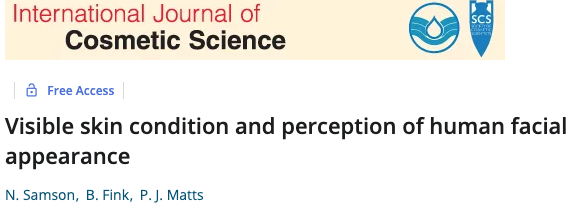
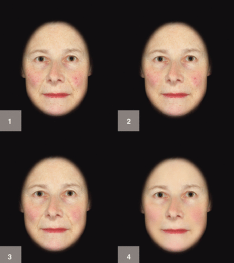
The study analyzes how we perceive different images altered with Photoshop. Once altered, they ran surveys asking people to guess the age, and the conclusion is that a face without redness is perceived as 10 years younger than a face without wrinkles, but if we improve both redness and wrinkles, the perception is 20 years younger. See fig.1
Improving the look of our skin is relatively simple; it can be achieved with an appropriate cosmetic routine, which you can start at home with cosmetic products suited to your skin's needs.
The most visible signs of age can be improved with aesthetic medical treatments; such as botulinum toxin, hyaluronic acid fillers, chemical peels, or IPL.
So it's clear what our initial goal should be: THE SKIN.
Now then, do we know our skin's needs?
Skin doesn't simply are; skin is in a state. By that I mean it's a living organ and it changes. The classification that our dear Helena Rubinstein invented—dry, oily, combination and sensitive—falls short for us. Today, mass-market brands still use it, but the reality is far more complex.
In the book The Skin Type Solution by Dr. Leslie Baumann, we can distinguish 16 skin types. The cosmetics industry has come a long way and, based on a meta-analysis of more than 5,000 scientific publications, has managed to identify the active ingredients that cover all of our skin's needs. It's a personalized cosmetic line of French origin; I'll leave you the link to the personalized cosmetics.
The personalized cosmetic line, Universkin, was founded by dermatologists and pharmacists and gives us the chance to make our own diagnosis from home through a link I'll leave below.
With the diagnosis you'll learn your skin profile; you'll receive something like fig. 2 in your email. This line is only available at medical centers, so you can choose the one closest to your home. In my case, I chose the De Felipe dermatology clinic.
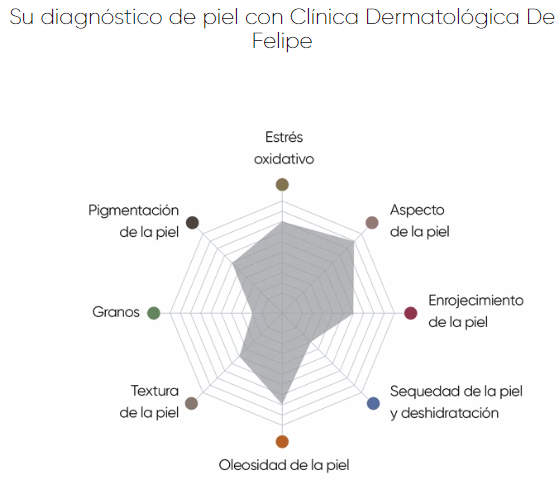
There are also some centers that do the "tele-diagnosis" for you and send the personalized serum to your home. Here's an example: Cosmeceuticalcenter
So, the most important thing—knowing our skin type—is told to us by this online application, with a test of roughly 10 minutes.
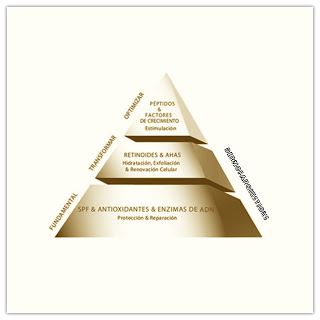
These days I'm following a basic beauty routine; I follow the pyramid of the guru Zoe Draelos, see fig.3—she calls them the "fundamentals": moisturizers with SPF. And you'll wonder..."why do I need sun protection at home?" Well, I'll tell you that visible light (from the computer, the desk lamp, the iPad, etc.) also stains the skin, producing hyperpigmentation.
My most basic routine for these days:
- Daytime:
- cleansing with gel + exfoliant + moisturizer (in my case a gel-cream, since my skin is oily)
- tinted cream/makeup with SPF 15++ (it protects me from visible light and IR).
- Nighttime:
- cleansing with micellar water or gel (depending on how oily the skin is)
- hyaluronic acid serum
- Once or twice a week: a hyaluronic acid mask. If you don't have one, you can make a mask with extra-virgin olive oil; it works for both face and hair.
If you want to level up, you can move to the "transform" level, which includes AHAs and retinoids—but it's essential to have an expert recommend it (a doctor or pharmacist) and/or to take the diagnostic test. I'd recommend following the pyramid of the guru Zoe Draelos. See fig. 3.
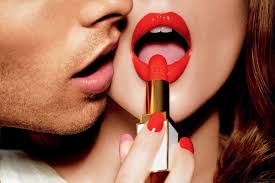
In short, on one hand find out which active ingredients suit your skin best at this moment in your life—you can do it online from your sofa—and on the other hand add color every day! Put on makeup, apply lipstick, add some blush, do your hair... feel beautiful. This is what's called functional cosmetics:
The body
Here things get complicated for us... two factors come together:
Lower calorie expenditure and higher calorie intake... a deadly combination born of necessity...
How do we fight what seems inevitable?
I'll start with something basic:
1.- Get dressed, don't stay in your pajamas! Establish a routine that keeps you from falling into neglect; the temptation to be in pajamas all day is right there. For many, being in pajamas is a great privilege, but since it's loose clothing it can lead you to eat more, gain weight, and barely even notice. Put on your usual clothes so that you'll notice if they feel tighter and you'll avoid falling into the vicious cycle of laziness...
2.- Control your appetite. This requires a stronger mental effort... but there are certain tricks that, besides being healthy, help us trick the stomach and reduce intake, for example:
- Have a glass of warm water on an empty stomach; you can add a few drops of lemon if you like it better, but the amount of Vitamin C is minimal. What you achieve is, first, hydration, and second, calming the "cravings" to dive into the pastries, the bread, etc....
- Exercise in the mornings, that way you activate your basal metabolism. Twenty minutes is more than enough; you can do it alone if you're used to it, or follow the tutorials out there, from apps like Nike Training, or, if you're going for the bare minimum, the Seven App, which straight away gives you a workout "compressed" into 7 minutes—so you've got no excuse....
- Weigh yourself! The first step to not gaining weight is to know what you weigh. It sounds silly, but there are a lot of people who simply don't make the effort, and I assure you that just weighing yourself already makes you aware of your weight throughout the day. If you don't do it, add it to your routine now. Once a week is enough.
My at-home exercise routine:
- Aerobic exercise: about 10–15 minutes. I do step using the typical "plastic step" from Ikea, the kids' one, and in my hands I hold a pair of 2kg dumbbells from Decathlon—but if you don't have any, you can use milk cartons or bottles.
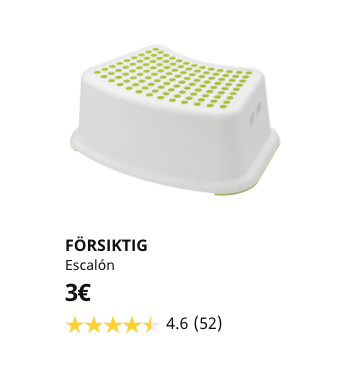
Grab the dumbbells (or milk cartons), step onto the step with your right leg, go up and down for 1 minute and then switch sides, and keep going for as long as you can hold out. You'll be working your glutes and your whole upper body with the milk cartons.
- Abs: sitting for so long can wreck our lower back, and if on top of that you're carrying the kids in your arms, even worse... a few each day always feel great; you can do them as a plank. Here's a very useful video from trainer Isabel del Barrio.
- Stretching, it's my favorite part. I do them with resistance bands—they sell them at Decathlon (like everything)—but if not, you can do them with the help of your partner, or your kids, who will surely be at home... stretching the legs well helps us drain, and with that, reduces cellulite and slims the legs. I do "diamonds" with my legs—both legs raised with the bands on my feet—and I do sets of 50 diamonds, then stretch each leg. This exercise "slims" the legs; here's a link to some exercises.

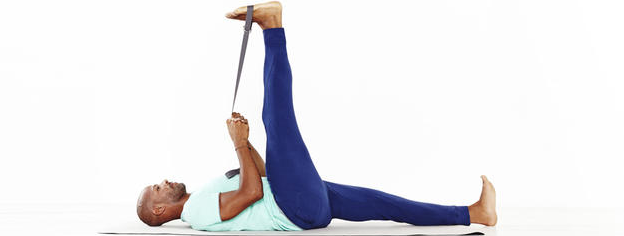
As you can see, you don't need to be a triathlete... about 20 minutes in total, but more than enough to maintain our muscle mass, our activity and our spirits!
The best antidepressant there is, is physical exercise!
Maria Cudeiro.
I hope you liked it and that you'll leave us a comment. :)
You can also share questions or thoughts at: info@womanandbusiness.com
Cargando comentarios...